 Español
 Licenses
How to Start Your FAA Private Pilot License (PPL): Your First Step Toward Flying
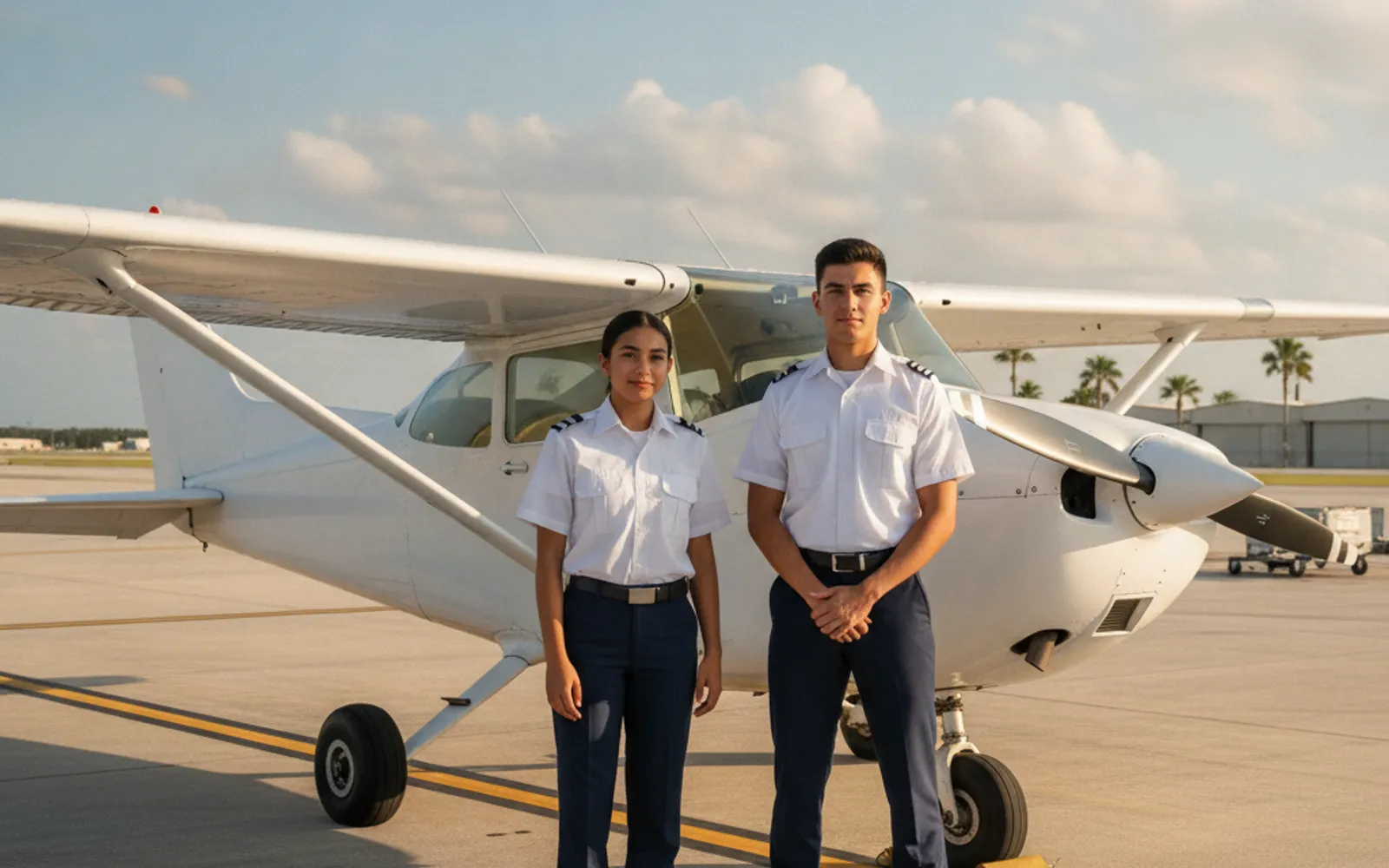
The Alpha Aviation Group is a professional flight school in Fort Lauderdale, Florida, that trains pilots from Latin America under FAA standards. Flying an aircraft for the first time as pilot in command is a moment many students remember for life, and it begins with the Private Pilot License (PPL). If you want to know how to take your first steps in aviation, here’s what the PPL is, what it’s for, and how to get started.
What is the Private Pilot License (PPL)?
The PPL is the first official license that allows you to fly an aircraft as pilot in command, without being paid for it. It’s the gateway into the world of aviation and the foundation on which the next stages of your training are built, such as the Commercial Pilot License (CPL) or the Instrument Rating (IR).
In the United States, the PPL is earned under FAA (Federal Aviation Administration) standards. Training under these standards gives you a solid, recognized foundation to continue your path toward a professional career.
Who is the PPL for?
The Private Pilot License is ideal for:
- People who want to begin their training as a professional pilot and need to take the first step.
- Those who want to fly for the love of it, without any intention of working as commercial pilots.
- Students from Latin America looking for a clear path toward a pilot career in the United States, starting from scratch.
You don’t need any prior aviation experience. What you do need is discipline, commitment to your studies, and a strong drive to learn.
What will you learn during PPL training?
PPL training combines theory with real flight time from early on. Some of the topics covered along the way include:
- Flight fundamentals: principles of aerodynamics, aircraft systems, and performance.
- Air navigation: how to plan a route and fly safely from one point to another.
- Aviation weather: understanding weather and its impact on flight decisions.
- Air regulations: the rules that govern airspace and aircraft operations.
- Supervised flight hours: hands-on practice with certified instructors in training aircraft.
- Aviation English: the language of aviation is English, and mastering it is a core part of your training, not a separate course.
At Alpha Aviation, we understand that aviation English isn’t an extra—it’s part of the journey from day one, especially for students from Latin America.
What do you need to start PPL training?
While specific requirements—such as minimum age, medical certificate, or immigration paperwork—should always be confirmed with the school’s admissions team, in general terms, to begin PPL training you can expect to need:
- The minimum age required under applicable regulations.
- A basic level of English, which continues to develop throughout the program.
- The appropriate personal and immigration documentation to study in the United States.
- To pass an aviation medical exam, the type and validity of which should be verified with the relevant authority.
If you have questions about how this applies to your situation, the best move is to speak directly with our admissions team. That way you avoid guesswork and get accurate information for your particular case.
Why train for your PPL in the United States?
Earning your PPL in the United States, under FAA standards, gives you access to:
- A large, diverse training airspace, ideal for building flight hours under a variety of conditions.
- Infrastructure and a fleet built specifically for professional pilot training.
- A clear path that continues on to the Commercial Pilot License (CPL) and additional ratings, without having to start over in a different system.
At Alpha Aviation, our campus is located in Fort Lauderdale, Florida, a strategic hub for aviation training in the United States. You can explore how the stages fit together in our pilot program.
What support do students from Latin America get?
We know that studying in another country is a big decision, both for you and your family. That’s why, as a division of The Alpha Aviation Group, we run The Airline Career Pathway, a program that guides international students in designing a clear route to build the competencies expected of future first officer candidates with airlines in the United States. Within that path, your flight training and the FAA licenses and ratings you earn take place with Alpha Flight Academy—one of the key competencies you’ll develop. Along the way you’ll find:
- Bilingual support in Spanish and English, designed for students coming from Latin America.
- A comprehensive program that takes you from the PPL through the CPL and additional ratings, with no standalone courses or fragmented paths.
- Close support throughout the entire process, designed to have a positive impact on your personal and professional growth, from your first inquiry to your flight hours.
Your first step starts today
The Private Pilot License is the beginning of a career that can take you much further. If you’re ready to become a pilot in the United States, backed by a comprehensive program and a team that speaks your language, now is the time to take the first step.
Contact us to get all your questions answered about how to start your PPL with Alpha Aviation, or schedule a call with our admissions team to learn the details of your process.
Frequently asked questions
What is a Private Pilot License (PPL)?
The PPL is the first official license that lets you fly an aircraft as pilot in command without being paid. It’s the gateway to aviation and the foundation for later stages like the Commercial Pilot License (CPL) and the Instrument Rating. At Alpha Aviation you earn it under FAA standards in Fort Lauderdale, Florida.
Do I need prior experience to start a PPL?
No. You don’t need any previous aviation experience to begin PPL training. What matters is discipline, commitment to studying, and a genuine drive to learn. A basic level of English helps, and it keeps developing throughout the program, since aviation English is part of the training from day one.
How long does it take to get a PPL?
The time varies for each student, depending on study pace, flight availability, and weather. Because Alpha Aviation combines theory with real flight time from early on, you build experience steadily. For a timeline that fits your case, talk with our admissions team about the training plan.
Where can I train for my PPL with Alpha Aviation?
Alpha Aviation’s campus is in Fort Lauderdale, Florida, a strategic hub for flight training in the United States, with access to diverse training airspace. Students from Latin America receive bilingual support in English and Spanish throughout the process.
What comes after the PPL?
The PPL is the starting point. From there you can continue toward the Commercial Pilot License (CPL) and additional ratings like the Instrument Rating, all within one comprehensive program with no fragmented courses. This lets you keep moving forward without switching systems.