
 Español
 Where you start
The instrument rating is included in Rookie — Level I ($92,901 standard), right after the PPL. Alpha does not sell it as a separate program.

The instrument rating in numbers
The Instrument Rating lets you fly under instrument flight rules (IFR), in clouds and low visibility. The FAA requires a private certificate, 40 hours of instrument time — 15 with an instrument instructor — and 50 hours of cross-country as pilot in command (14 CFR 61.65). At Alpha, it is part of Rookie — Level I.
 40 h instrument Actual or simulated instrument time, 15 h of it with a CFII (61.65(d)).
  50 h cross-country As pilot in command, at least 10 h in airplanes.
  250 nm IFR flight One instrument cross-country with three kinds of approaches.
 14 CFR 61.65(a) requires you to:
Part of the instrument time can be logged in an FAA-approved flight simulator or training device, within the limits of 61.65(i).
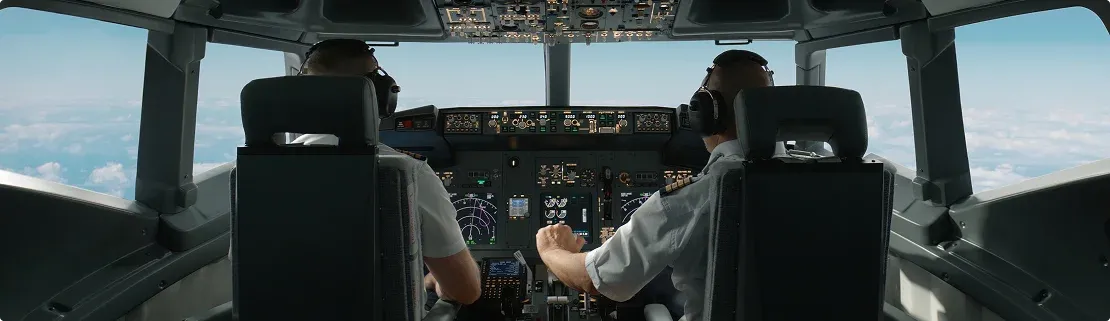
14 CFR 61.65(d) requires:
| Requirement | FAA minimum |
|---|---|
| Cross-country time as pilot in command | 50 h, at least 10 h in airplanes |
| Instrument time (actual or simulated) | 40 h |
| Instrument training with an instrument instructor (CFII) | 15 h of the 40 |
| Checkride preparation | 3 h within the 2 calendar months before the test |
| IFR cross-country with an instructor | 250 nm along airways or ATC routing, an approach at each airport, 3 kinds of approaches |
Solo cross-country time logged during PPL training counts as pilot-in-command time toward the 50 hours.
Airline flying is instrument flying. A commercial pilot without an instrument rating cannot carry passengers for hire on cross-country flights over 50 nm or at night (14 CFR 61.133).
Where you start
The instrument rating is included in Rookie — Level I ($92,901 standard), right after the PPL. Alpha does not sell it as a separate program.
What comes next
Licensed in another country?
EASA or ICAO commercial pilots enter at Level II ($60,914 standard), which includes the FAA instrument rating. With another license, your entry level depends on what you hold. Admissions reviews your license and logbook and confirms your level and price — see the cost guide.
Fly under instrument flight rules (IFR), including in clouds and low visibility, using the aircraft’s instruments and air traffic control (14 CFR 61.3(e)). Without it you can only fly in visual conditions.
Yes. You must hold at least a private pilot certificate, or be applying for it at the same time (14 CFR 61.65(a)). In Rookie — Level I, the instrument rating comes after the PPL.
The FAA minimums are 50 hours of cross-country as pilot in command and 40 hours of actual or simulated instrument time, 15 of them with an instrument instructor (14 CFR 61.65(d)). These are minimums, not a forecast.
Partly. The FAA lets you credit some instrument time in approved flight simulators and training devices, within the limits of 14 CFR 61.65(i). The rest is flown in an airplane, including the 250-nm IFR cross-country.
Possibly. The FAA can issue a U.S. private certificate on the basis of a foreign license (14 CFR 61.75), and your entry level depends on what you already hold. Admissions reviews your documents and explains the level and price that apply.
Questions about your case? Contact admissions in English or Spanish.