 Español
 Training
The Great Debate: Would You Fly in a Plane with Only One Pilot?
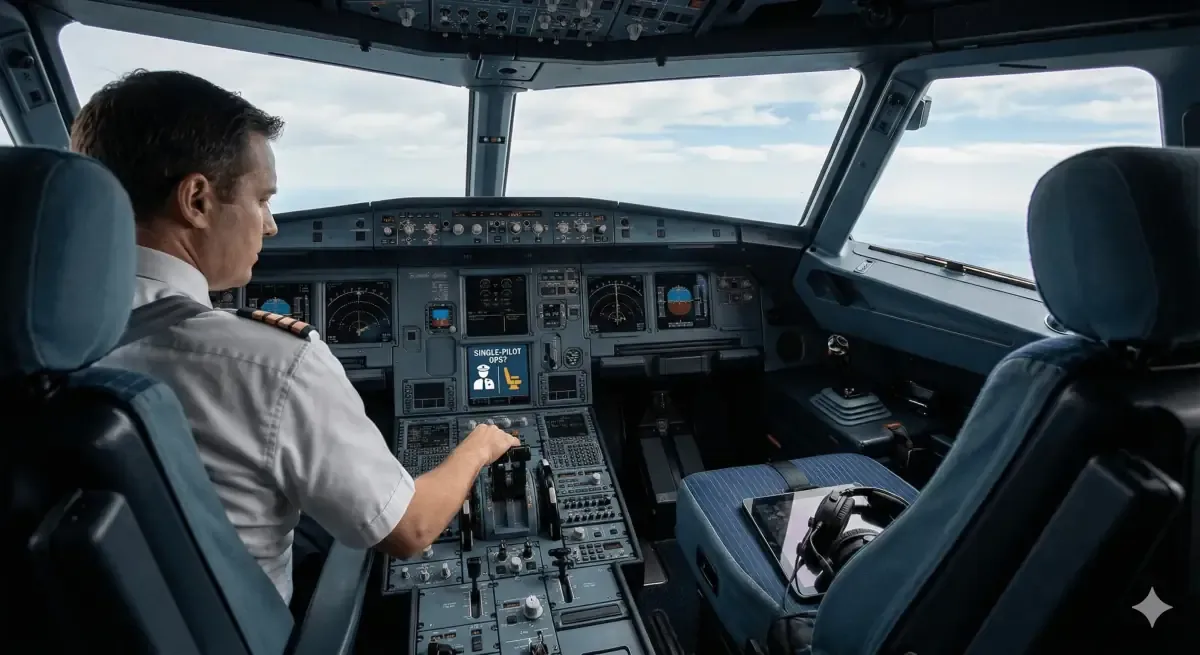
For decades, the golden rule in commercial aviation has been clear: there are always two pilots in the cockpit. One flies, the other monitors. However, one of the most controversial news stories currently is the pressure from some manufacturers and airlines to change this.
The concept is called eMCO (Extended Minimum Crew Operations) and proposes that, during the cruise phase, a single pilot remains at the controls while the other rests, or even eliminating the second pilot entirely in the future.
The argument in favor: Technology and Shortage
Proponents of this idea, supported by advances in automation and Artificial Intelligence, argue two key points:
- Current technology already does most of the work during cruise flight.
- It would help alleviate the global pilot shortage facing the industry.
The pilots’ stance: “Safety is not negotiable”
Organizations like ALPA (Air Line Pilots Association) have launched aggressive campaigns against it, under the slogan “Safety Starts with Two.”
Their argument is irrefutable: no technology can replace human judgment and the ability to react in a complex emergency, like the famous “Miracle on the Hudson.” If a pilot becomes incapacitated (due to a medical issue, for example), the second pilot is the only infallible backup system.
What do EASA and the FAA say?
Regulators are studying the issue cautiously. While EASA (Europe) has suggested it might consider single-pilot operations in the cruise phase by 2027, the FAA in the United States appears much more skeptical.
The human factor
Beyond technology, the most important question remains: are passengers willing to board a plane knowing there is only one person in command?
For now, the copilot’s seat remains mandatory, but the debate over the future of the cockpit is more alive than ever.