 Español
 Training
From Gamer to Pilot: How Virtual Reality is Changing Flight Training
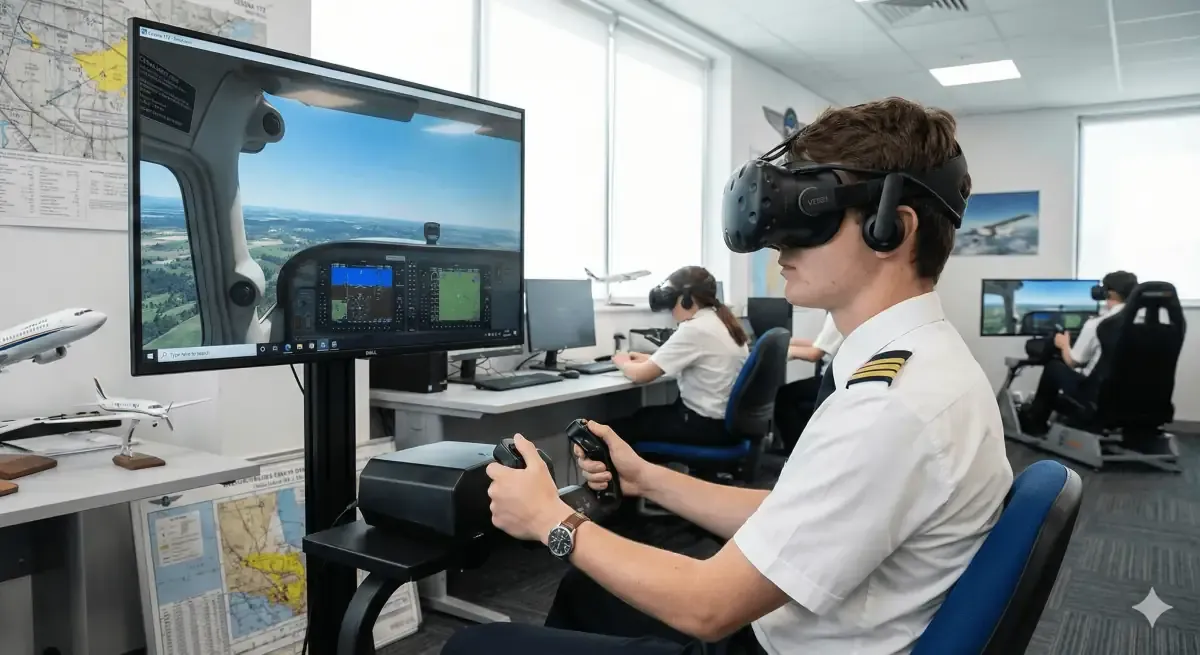
If you are from the generation that grew up with a console in hand or playing simulators on PC, you have an unexpected and powerful advantage. The line between high-fidelity video games and professional flight training is blurring thanks to Virtual Reality (VR), Mixed Reality (MR), and advanced consumer software.
Forget sitting in front of a paper poster of the cockpit to memorize buttons (“chair flying”). Now, students put on a VR headset and “step” into the plane from their bedroom, interacting with every switch as if it were real.
The Science Behind the Game: “Transfer of Learning”
For years, old-school instructors dismissed home simulators, claiming they taught “bad habits.” Today, science says otherwise. There is a phenomenon called “transfer of learning.”
Platforms like Microsoft Flight Simulator 2020 or X-Plane 12 have aerodynamic physics and systems modeling so precise that a student can learn the logic of the G1000 (glass cockpit avionics) before ever stepping foot in a flight school.
- Real Result: Students who use home simulation typically require fewer hours of in-air instruction to master radio communications and navigation, translating into thousands of dollars in savings.
Learning by flying (without burning fuel)
Traditional aviation always had a problem: flying is expensive (plane rental plus instructor can exceed $200 USD per hour). But with the integration of VR, the operating cost drops to zero.
- Total Immersion and VFR: Unlike a flat screen, VR allows you to turn your head to see the runway while flying a traffic pattern, look for visual references on the ground, or scan the sky for other aircraft. This develops “situational awareness” long before stepping into the real plane.
- Muscle Memory: You can practice emergency procedures (like an engine failure on takeoff) by moving your hands in a 3D environment. Your brain records the physical action, not just the theory.
The Air Force, Airlines, and Mixed Reality
It’s not a toy. The U.S. Air Force uses VR through its “Pilot Training Next” program to accelerate the training of its fighter pilots.
Furthermore, the technology is evolving into Mixed Reality (MR), where you wear a headset that allows you to see your own hands and a real physical instrument panel, but the outside world is computer-generated. Companies like Varjo are leading this, allowing pilots to read real navigation charts inside the simulation.
The end of boring training
For Gen Z and Alpha, this makes studying much more natural and engaging. The gamification of learning allows for instant feedback and competing with oneself to improve landing smoothness or navigation precision.
If you are a home simulator expert, the leap to the real cockpit will be much less intimidating. Your weekend “addiction” is now a legitimate professional skill.