
 Español
 Training
Crossing the Atlantic on Cooking Oil: The Milestone of the 100% Sustainable Flight
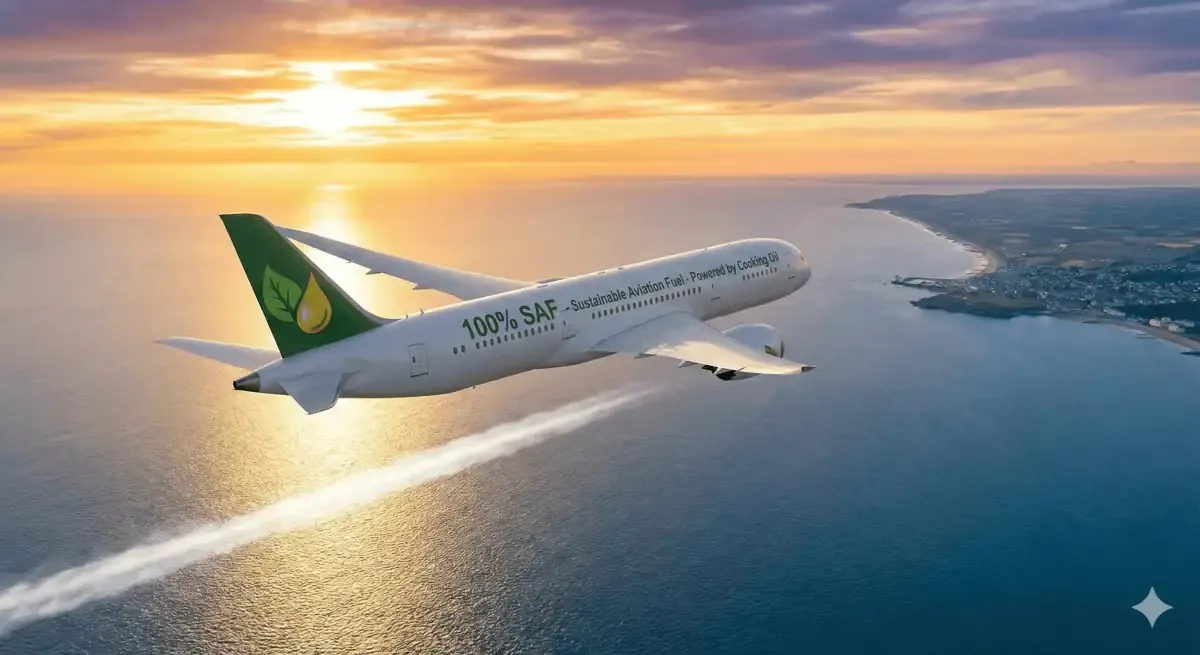
Aviation has a giant challenge: decarbonization. For years, it was thought that the only solution would be to wait decades for hydrogen planes or electric batteries. However, a recent flight has proven that the solution is already here.
Virgin Atlantic conducted the first commercial transatlantic flight (London to New York) powered by 100% Sustainable Aviation Fuel (SAF), marking a turning point in the industry.
What was special about this fuel?
What is fascinating is not just that the plane crossed the ocean, but what the fuel was made of. There was not a single drop of fossil oil.
- 88% of the fuel came from processed esters and fatty acids (basically, waste fat and used cooking oils).
- 12% came from synthetic aromatic kerosene derived from corn waste.
No tricks or engine changes
The most important fact for pilots and airlines is that the flight was performed on a Boeing 787 with standard Rolls-Royce Trent 1000 engines.
This proves that SAF is a “drop-in” fuel: it can be used in aircraft that exist today, without the need to modify engineering or airport infrastructure.
Why don’t we use it on all flights?
If it works so well and reduces carbon emissions by up to 70%, why isn’t it the standard? The problem is availability and cost.
Currently, SAF represents less than 0.1% of global aviation fuel and costs between three and five times more than traditional kerosene.
A greener future
This historic flight has served to pressure governments and investors. The technology works; now the challenge is to scale production so that, in the near future, flying does not mean leaving a heavy footprint on the planet.